
When should an open tibial fracture be fixed definitively in a ring rather than converted to a nail or plate? The answer depends on the wound, the bone loss and the joint – not on habit.
What the evidence says
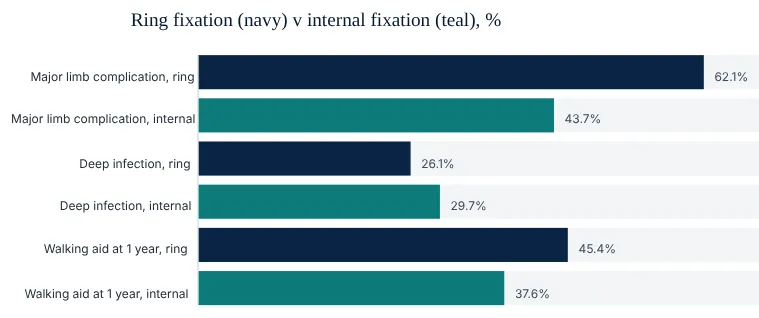
- FIXIT did not show the ring to be better than internal fixation for the average severe open tibial shaft fracture.
- In pooled trials against nailing, external fixation had more superficial infection and malunion, fewer hardware failures, and similar deep infection, union time and nonunion.
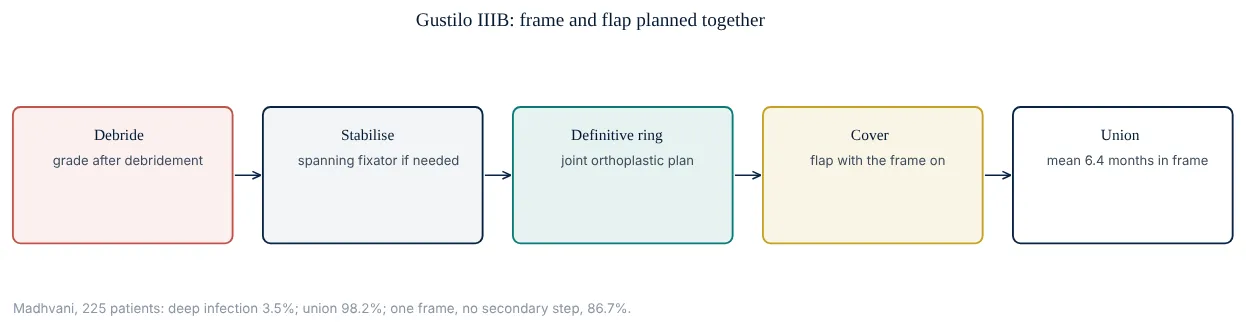
- In Gustilo IIIB fractures under orthoplastic care, definitive circular frames united in about 98%, most in a single frame, with deep infection around 3.5% (Madhvani, 225 patients).
Where the ring is the right answer
- Bone loss, segmental or highly comminuted fractures that a nail cannot hold.
- Contaminated wounds where an internal implant would be at risk.
- Fractures extending towards the knee or ankle, and the child or the osteoporotic older patient.
- When the frame can later be used for acute shortening and relengthening or bone transport.
Temporary intentional deformation
For a soft-tissue defect larger than the bone gap, the tibia can be acutely shortened and angled in the frame so the wound closes without a flap, then straightened and relengthened gradually once the skin has healed.
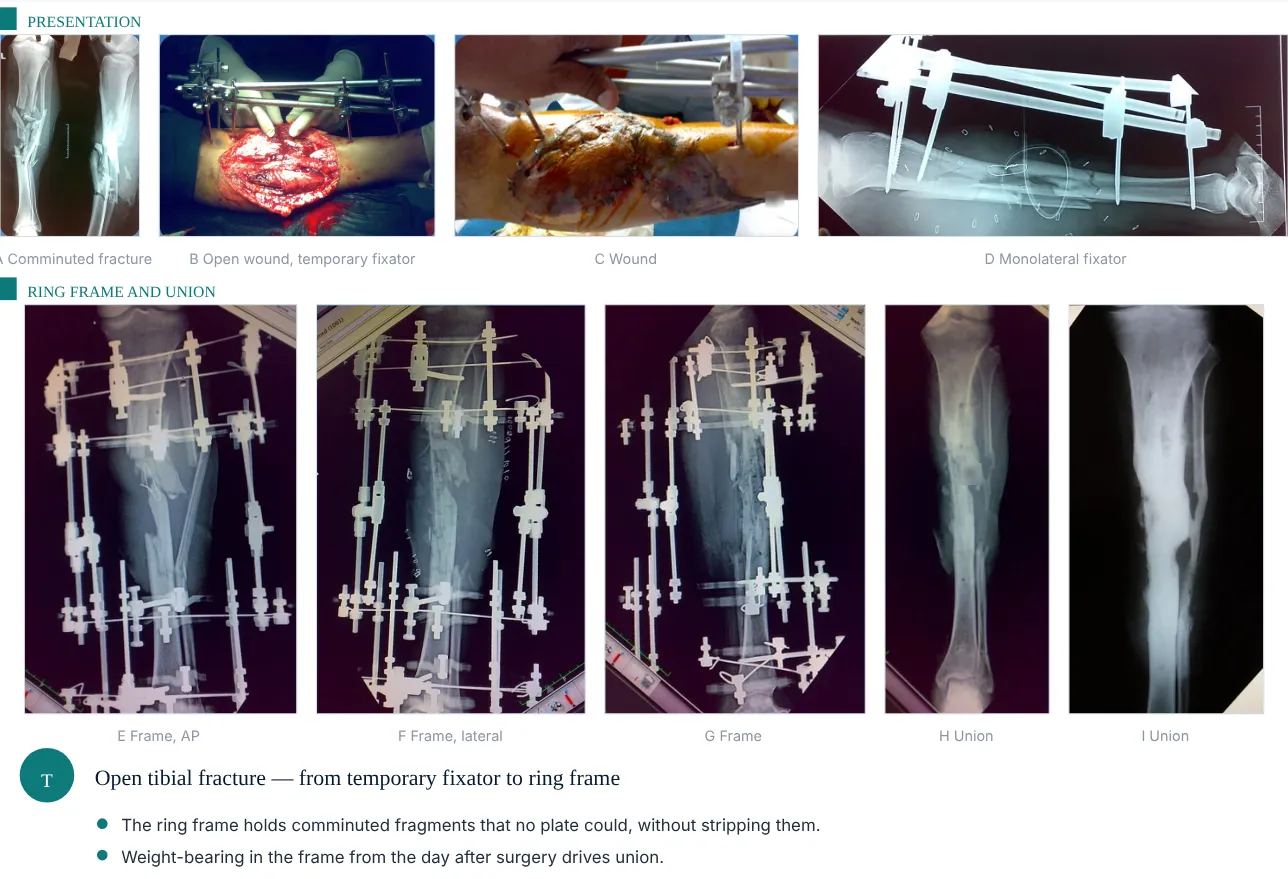
A case from Dr. Hoda’s practice
📖 Read more in the free textbook
[Chapter 73A – Ilizarov Fixation in Open Tibial Fractures](https://ilizarovprinciples.com/chapters/073a-ilizarov-fixation-in-open-tibial-fractures/) · [Chapter 71 – Classification of Open Fractures](https://ilizarovprinciples.com/chapters/071-classification-of-open-fractures-gustilo-anderson-ao/) · [Chapter 79 – Combined Bone & Soft-Tissue Trauma](https://ilizarovprinciples.com/chapters/079-combined-bone-soft-tissue-trauma/)
From Ilizarov Principles & Limb Reconstruction by Dr. Shamsul Hoda – ilizarovprinciples.com. Figures reproduced from the book.
Lectures and surgical videos by Dr. Hoda
 ▶
 ▶
 ▶
 ▶
 ▶
References
- METRC FIXIT Investigators. Modern external ring fixation versus internal fixation for severe open tibial fractures: a randomized clinical trial. J Bone Joint Surg Am. 2022.
- Madhvani K, et al. Definitive circular frame fixation of Gustilo IIIB tibial fractures. 2024.
- Nho SJ, Helfet DL, Rozbruch SR. Temporary intentional leg shortening and deformation to facilitate wound closure using the Ilizarov/Taylor Spatial Frame. J Orthop Trauma. 2006;20:419–424.
Related
Bone transport for an infected tibial gap · Complex trauma (patients) · Clinical cases
Ready to discuss your case?
Book a consultation in Patna or Hajipur, or send your X-rays on WhatsApp for an initial opinion.
