
Pin-tract problems are the most common complication of external fixation. Most are minor and treatable, but neglected pin sites lead to loosening, osteomyelitis and failure of treatment. Good technique in theatre and simple daily care prevent most problems.
Prevention starts in theatre
- Insert wires and pins through safe corridors, away from tendons and large muscle bellies where possible
- Avoid heat necrosis: sharp wires, low-speed drilling, cool saline irrigation, pause between bursts
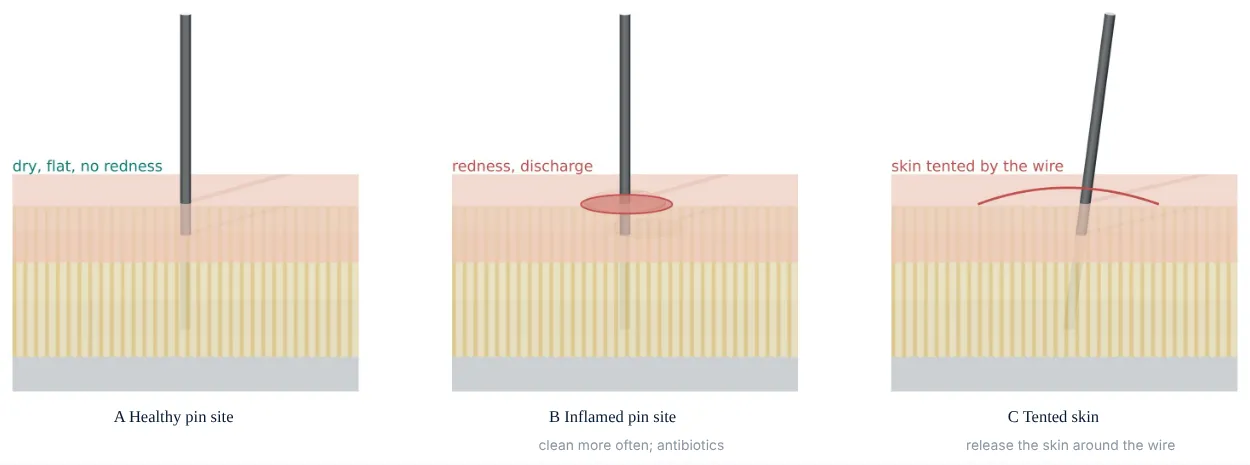
- Release skin tension around each wire – skin must not tent over it
- Position joints correctly when passing wires through muscle (e.g. knee flexed for posterior femoral wires)
- Hydroxyapatite-coated half-pins reduce loosening
Daily care
- Hand washing before care
- Clean each site with sterile saline or the solution prescribed by your unit, using a separate swab for each pin
- Remove crusts gently; avoid ointments and home remedies
- Light dressings or sponges help limit skin movement around the pin
- Teach the patient and a family member before discharge and check technique at follow-up
Grading pin-tract infection (a practical approach)
- Grade 1 – Inflammation: redness, mild discharge → more frequent cleaning
- Grade 2 – Superficial infection: redness, discharge, tenderness → oral antibiotics, cleaning
- Grade 3 – Infection with loosening: loose pin or wire → antibiotics; replace or remove the pin or wire
- Grade 4 – Deep infection / ring sequestrum: X-ray changes → remove the pin, debride the track, antibiotics; may need curettage (Several published classifications exist – e.g. Checketts–Otterburn and Dahl – use one consistently in your unit.)
When to call the surgeon
- Fever, spreading redness, increasing pain or pus
- A wire or pin that has become loose or is moving
- Pain on weight-bearing that is new or worsening
Key message
Careful insertion, skin release and consistent daily care prevent most pin-tract problems. Grade early and treat early.
Patient guide in Hindi: /hi/frame-ki-dekhbhal
📖 Go deeper – free textbook chapters
[Chapter 70A – Postoperative Care in the Frame](https://ilizarovprinciples.com/chapters/070a-postoperative-care-in-the-frame/)
Related note: Postoperative care in the frame
From Ilizarov Principles & Limb Reconstruction by Dr. Shamsul Hoda – ilizarovprinciples.com.
Lectures and surgical videos by Dr. Hoda

Ready to discuss your case?
Book a consultation in Patna or Hajipur, or send your X-rays on WhatsApp for an initial opinion.
